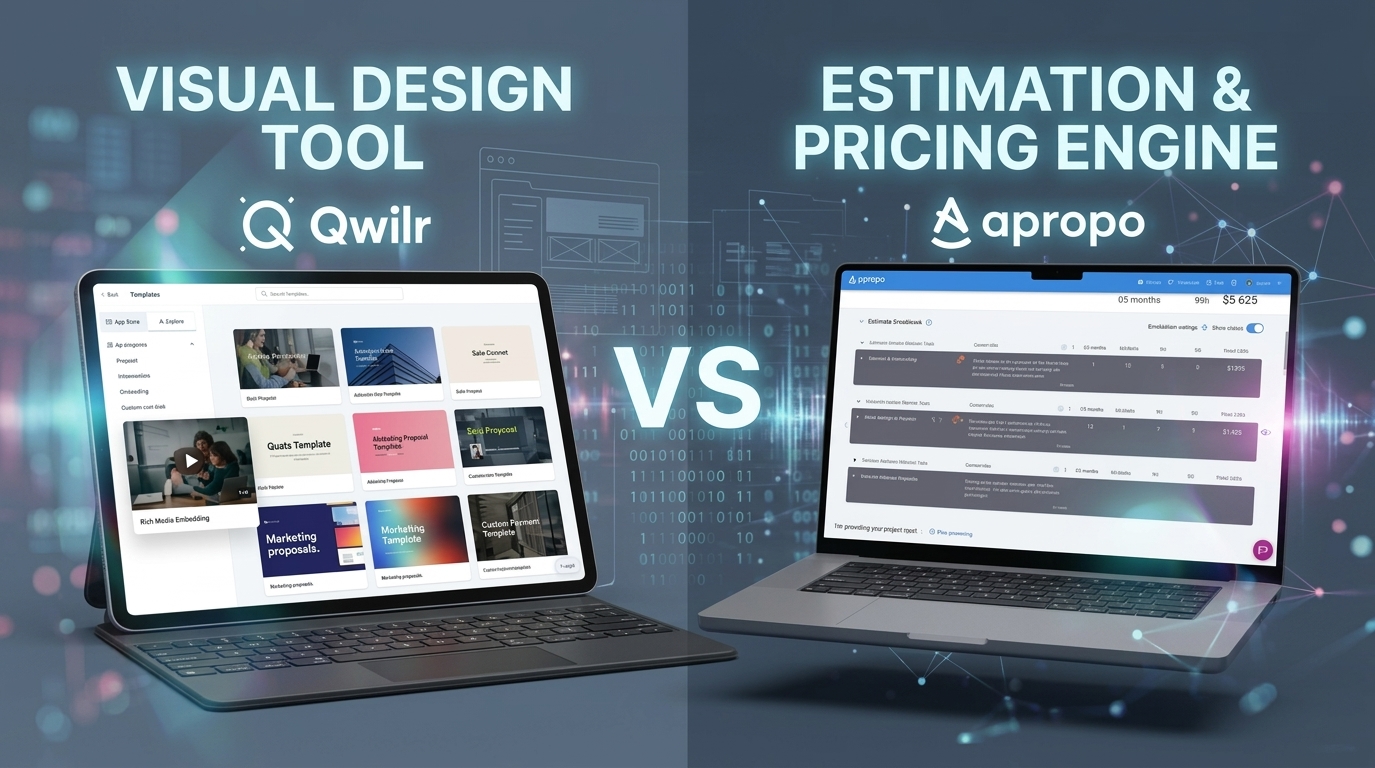
If you run a software agency, you’ve probably looked at Qwilr. It is a polished proposal tool: web-based pages, good templates, pricing tables, eSignature, and engagement tracking. For many agencies, that is exactly what they need.
The question is whether it solves the part of the sales process that usually hurts most: estimating the software project.
A proposal can look excellent and still be built on a weak estimate. Someone still has to decide what belongs in the scope, how much work it will take, and whether the final price can survive a conversation with the buyer. Qwilr helps present that decision. apropo.io also helps make it.
This is not a case for declaring Qwilr a bad product. The two tools start from different problems, and that difference matters when the work being sold is custom software.
Qwilr and apropo.io solve different parts of the sale
Qwilr is a proposal design and quoting platform. You use it to create interactive, web-based proposals that can look more like landing pages than documents. Videos, pricing tables, eSignature, and buyer engagement tracking all fit naturally into that model. Buyers can select packages, optional line items, or quantities and see the quote total update.
apropo.io is built around estimation and quoting for software agencies. It combines the proposal with component-based estimation, market benchmarks, and buyer behavior analytics. An agency can build a component library from past work, turn previous estimates into reusable knowledge, and let the client interact with the scope rather than simply read a final number.
That distinction is easy to miss if both products are compared only by their proposal editor.
A comparison based on the problems software agencies actually have
| Problem | apropo.io | Qwilr |
|---|---|---|
| Interactive web proposal (link, not PDF) | ✅ Live pricing: the client toggles scope items and sees the price and timeline change | ✅ Interactive pricing and quote options; buyers can select packages, add-ons, or quantities and see the total update |
| Client modifies scope in the proposal (deselect optional = price drops) | ✅ Live estimation table with optional scope items | ✅ Buyers can select or deselect optional quote items and packages; Qwilr recalculates the quote total |
| In-proposal comments | ✅ Client and agency can discuss the proposal in place | ❌ No comparable scope-commenting workflow found in Qwilr’s public product documentation |
| Buyer session recording | ✅ Mouse tracking, viewed sections, time spent, and active versus idle time | ⚠️ Engagement analytics: opens, viewed content, clicks, and time spent |
| Email notification when the client opens the proposal | ✅ | ✅ |
| Estimation based on the agency’s own data | ✅ Component library, past-estimate knowledge base, and MCP + AI agent for structuring internal documents | ❌ |
| Margin protection against scope creep | ✅ | ❌ |
| eSignature | ❌ | ✅ |
| Proposal templates for sales teams | ✅ | ✅ |
The gap is not mainly about presentation. It is about what happens before the proposal reaches the buyer, and how much of a software estimate the buyer can explore after opening it.
Why a proposal editor is not enough for software projects
A custom software project rarely arrives with a perfectly fixed scope. The requirements change as the client learns what is possible. A feature that looks small in a first conversation may involve an awkward third-party integration, an old internal system, or an API that does not behave as expected.
That creates a pricing problem. When a CFO asks, “Why does this cost $80k?”, the answer cannot be a nicely formatted page. The agency needs a defensible estimate behind it.
Qwilr is useful once those decisions have already been made. It does not provide the component libraries, cost data, market benchmarks, or estimation workflow needed to make them. In practice, that work stays in spreadsheets, emails, or someone’s memory.
What apropo.io adds to the estimation process
Estimates built from the agency’s own work
The component library in apropo.io comes from the agency’s past estimates and delivered projects. That gives the team a place to keep reusable pieces of work together with the effort data behind them.
Previous estimates can be imported and structured into templates. The point is simple: the next estimate can use evidence from work the team has already done instead of starting from a blank spreadsheet every time.
The apropo MCP and AI agent can also connect internal documents such as technical specifications, old proposals, and delivery notes. The agent extracts relevant information and adds it to a structured knowledge base. That is useful when the information exists, but is scattered across documents nobody wants to read again.
A proposal where the client can test the scope
With apropo.io, the client sees a live estimation table rather than a fixed total. Optional items can be switched on or off, and the price and timeline update immediately.
The client can also leave comments directly on the proposal. That gives the agency a place to discuss a scope decision without starting another email thread, while the session recording shows which parts of the proposal received attention.
You can see whether the buyer opened the proposal, where they moved the mouse, which sections they lingered on, and how long the session stayed active. Those details will not replace a sales conversation, but they can make the follow-up less speculative.
Results reported by software agencies using apropo.io
Apropo says it is used by more than 400 companies. The public case studies include software agencies such as these, with the following reported results:
- Divante: client-friendly quotes created 40% faster
- Spyrosoft eCommerce: 10% sales increase
- Pagepro: estimates completed 3.5 times faster
- NoA Ignite: approximately 5 hours saved on every quote
- Profil Software: 1.8 times higher conversion rate
These figures come from Apropo customer case studies, not from an independent comparative study. See the full apropo.io case studies.
Which tool fits your sales process?
apropo.io is the stronger fit when the difficult part of selling is estimating custom software. That usually means the agency wants to reuse knowledge from previous projects, explain its pricing, and let buyers adjust optional scope before the project starts. Buyer behavior data is useful here too, especially when a proposal contains several sections or pricing choices.
Qwilr makes more sense when the estimation process already works elsewhere and the main requirement is a polished proposal with eSignature. It can also be a reasonable choice for a creative agency or freelancer sending simpler proposals, where the scope does not need a dedicated estimation layer.
There is no reason to move an already reliable estimation process just to replace the proposal editor. The comparison changes when spreadsheets and informal notes are the thing holding the sale together.
The short answer
Qwilr is good at presenting a proposal. apropo.io connects that proposal to the estimation work behind it.
For a software agency, that connection affects more than the appearance of the document. It affects whether the scope can be discussed clearly, whether the price has a defensible basis, and how much margin is left when the project starts.
Software agency presales
Need more than a proposal editor?
Connect the client brief, estimate, proposal and Jira handoff in one workflow.
See the complete workflowFAQ
What is the main difference between apropo.io and Qwilr?
Qwilr focuses on visually polished, interactive proposals and quotes with eSignature, payments, and buyer engagement tracking. apropo.io combines interactive proposals with component-based estimation, market benchmarks, and buyer behavior analytics. The main difference is the estimation layer behind the proposal.
Can Qwilr handle software project estimation?
Qwilr is a proposal design and quoting tool rather than a software estimation platform. It does not provide the software-estimation workflow Apropo is built around: reusable development components, role-based effort estimates, historical delivery data, and software-project scope modelling.
Does apropo.io offer interactive proposals like Qwilr?
Yes. Clients can open a web-based proposal, toggle optional scope items, see pricing changes immediately, and leave comments. The agency also receives session recording and engagement data.
Which tool is better for a software agency that needs to estimate projects?
apropo.io is designed for that use case because it combines estimation with the proposal. Qwilr focuses on proposal presentation, quoting, and eSignature, so it fits better when estimation is already handled elsewhere.
How much does apropo.io cost compared to Qwilr?
Qwilr Business costs $35 per user/month when billed annually, or $39 per user/month when billed monthly. Its Enterprise tier is listed at $59 per user/month when billed annually and requires a 10-user minimum. apropo.io pricing is tailored to software agency needs, so the price depends on team size and requirements.