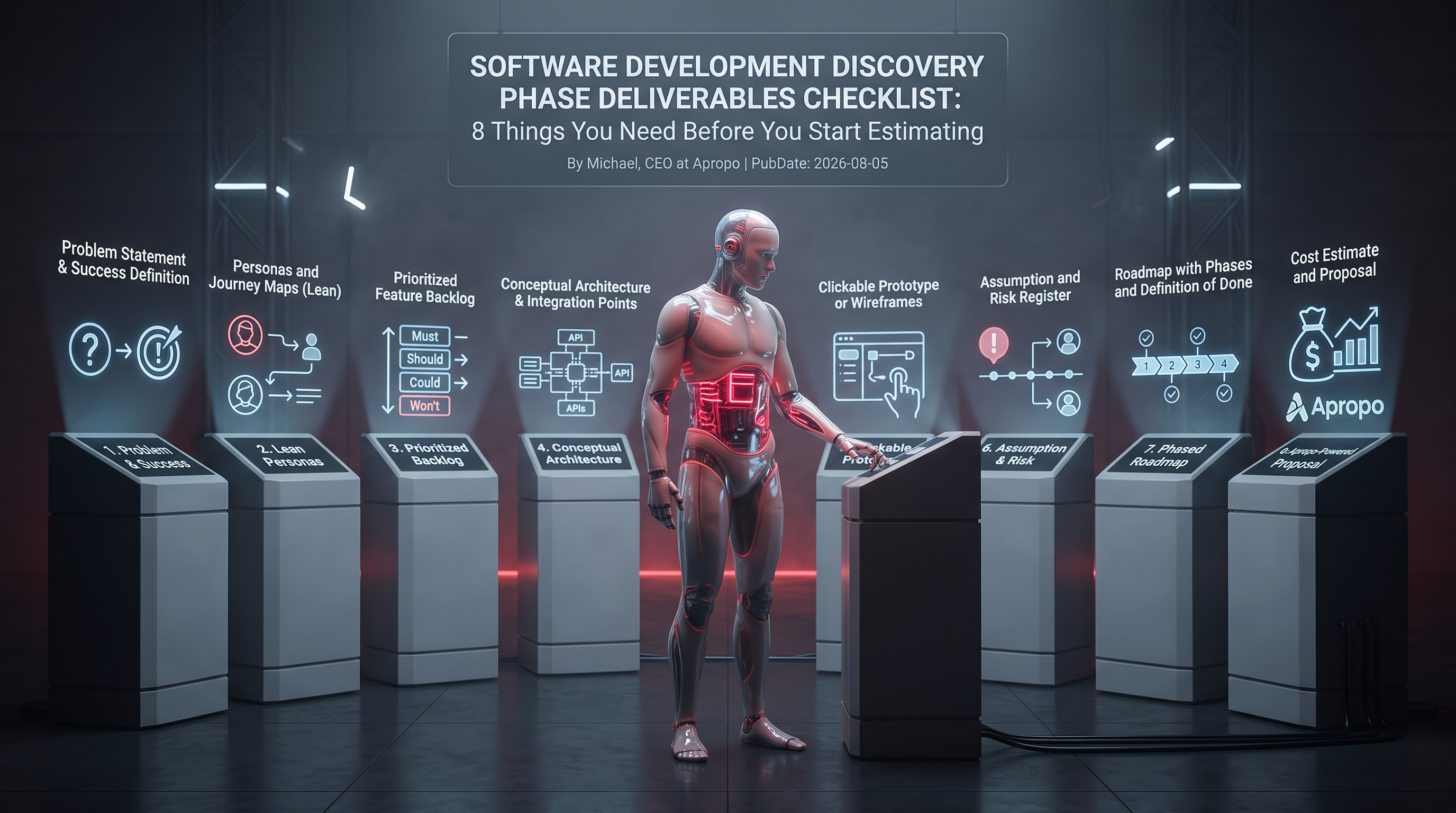
Most guides about discovery are really about the process — the workshops, the research, the requirements gathering. Walk out of that room, though, and only one thing matters: what actually got produced. This software development discovery phase deliverables checklist covers the 8 things that have to exist before you sit down to estimate. Miss one and you don’t have a discovery. You have meetings, and guesswork.
Where the Problem Starts
Search “software development discovery phase deliverables checklist” and you land on software agency blogs — OS-System, Redwerk, NIX United, Shakuro, Agilie, iTechCraft. They all describe discovery as a process. None of them tells you what should come out of it, or how to tell when a deliverable is actually ready to estimate off.
Meanwhile a thread pops up on Reddit every few weeks — r/softwaredevelopment, r/agency — always the same shape: “we finished discovery, we’ve got 40 pages of notes, and we still don’t know what this costs.” That’s not a process problem. That’s a deliverables problem. Discovery with no concrete outputs is a cost, not an investment.
Why It Hurts
Every missing deliverable hits the same place, and that place is margin.
Without success criteria, your problem statement is just a wish — you can’t price what you can’t define. Personas built from imagination give you the wrong priorities, so you end up estimating features nobody will ever use. A backlog with no priorities means you can’t carve out an MVP or phase the project. No integration list on the architecture, and the technical risk surfaces mid-delivery, when changes are priciest. Skip the prototype and you’re signing up for change requests. Skip the assumptions and you’re signing up for disputes. No risk register, and every surprise gets funded straight out of your margin. And an estimate that isn’t tied to the scope isn’t defensible — not to the client, not to your own team.
How to Fix It
1. Problem Statement and Success Definition
One sentence: who is this for, what problem are we solving, and how will we know it worked. If you can’t pull a measurable goal out of that sentence, it isn’t done yet.
2. Personas and Journey Maps (Lean)
Three to five personas, each with a real job-to-be-done, a usage context, and constraints. Give each one a scenario you can actually picture. If you can’t, you’re writing fiction.
3. Prioritized Feature Backlog
Every feature, ranked — MoSCoW or RICE — with a rough size attached. The test here: could you cut an MVP without scheduling another meeting?
4. Conceptual Architecture and Integration Points
Tech stack direction, the integration list, external dependencies. Walk each integration and mark it known, to verify, or risky. The ones left unmarked are the ones that bite later.
5. Clickable Prototype or Wireframes
A flow the client can literally click through. The key question: has the client accepted the main paths? That acceptance is what makes your estimate stick.
6. Assumption and Risk Register
Every assumption written down, with an owner and a deadline to verify it. If an assumption can’t be checked before delivery, flag it now — don’t discover it in month four.
7. Roadmap with Phases and Definition of Done
Phases with dependencies, acceptance criteria, go/no-go points. You want to be able to bend the scope between phases without reaching for a contract amendment every time.
8. Cost Estimate and Proposal
Effort per module and per phase, rates, a risk buffer, assumptions spelled out. Every line item should survive a “why is this here?” from the client or from your own team.
Where Apropo Comes In
That last deliverable — the estimate and proposal — is exactly where Apropo does its thing. Instead of copying the scope into a spreadsheet and hoping, you build the proposal from a component library made of your own projects. The assumptions and risks from discovery land in the proposal as visible items. And after signing, the same data quietly collects actuals — so your next discovery is estimated from data instead of gut feel.
Summary
Discovery isn’t a document. It’s a set of estimation tools. Eight deliverables, each with a check you can run. Miss one and you’re not ready to estimate. You’re ready to guess.
Connect your presales workflow
Turn discovery deliverables into a proposal-ready workflow.
Carry scope, risks and estimates forward without rebuilding the project in another tool.
See the complete workflow