The lead is ready to buy. The client asks for a quote, but a proper estimate needs three days of a senior person’s time. Nobody has three days. The quote goes out late or with gaps.
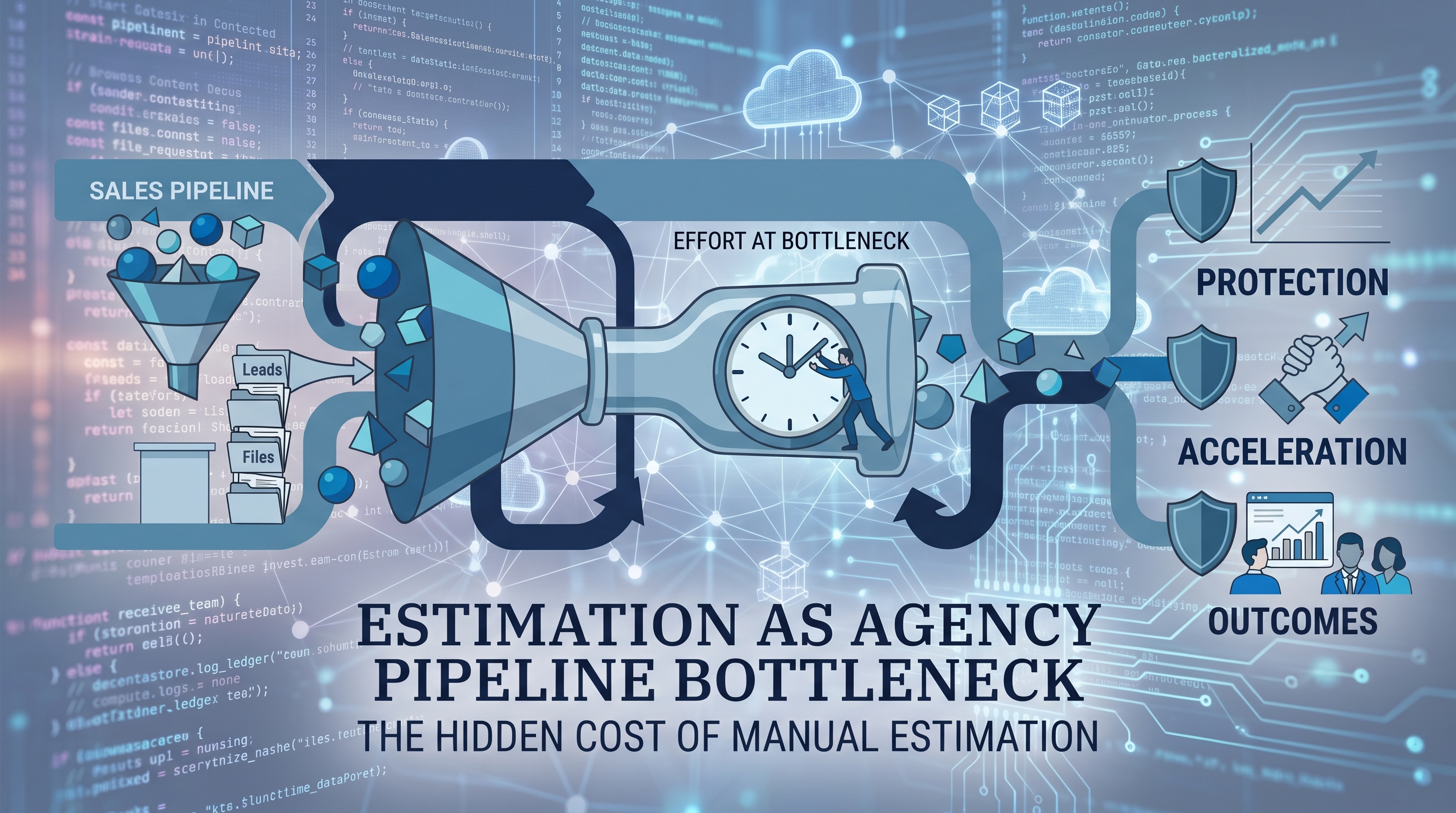
This is common in software agencies. Estimation, rather than price or code quality, becomes the bottleneck in sales.
This article explains what that bottleneck costs, why it happens, and how historical data and automated proposal assembly can remove it without lowering quality.
How much time estimation takes before you quote
In a typical software agency, quoting a project takes this work:
- Discovery and analysis. One to two days to gather requirements and resolve gaps.
- Estimation. A team lead prices each module in a spreadsheet. A mid-size project takes 4-8 working hours, often spread across a week because it waits for an open slot.
- Proposal writing. Turning the estimate into a client-ready offer with margin, risk, and buffer calculations takes another 4-8 hours.
- Internal review. The team checks the numbers, collects approvals, and revises the offer after sales feedback.
One polished proposal can take two to five working days from a capable engineer. A quick guess may save time before the sale, but delivery then pays for the missing work.
Why estimation becomes the bottleneck
In many agencies, the quote limits sales capacity. These are the main reasons.
It sits on the calendar of your most experienced people
You cannot hand estimation to a junior team member. A poorly calibrated quote can make the project unprofitable. The same senior person estimates each deal while running projects and speaking with clients. When deadlines arrive, estimation takes time from billable work. Sales and delivery both slow down.
Every day of delay cools the lead down
The longer a client waits for an offer, the more likely they are to choose a competitor or abandon the purchase. Response speed affects whether a lead progresses. When estimation delays every quote, win rate falls.
Proposal throughput is hard-capped
If one thorough estimate takes half of a senior person’s week, the agency can send only a handful of offers each month. More leads simply wait for the estimator. Estimation capacity, not demand, limits sales.
The hidden cost, in actual money
This cost often does not appear in a report, but it reduces margin every day:
- Senior time. Every hour spent estimating is an hour unavailable for delivery.
- Lost leads. When a prospect leaves while waiting for a quote, the agency loses the acquisition spend behind that lead.
- Margin errors. Under pressure, teams may price too low to send an offer quickly. They may also add a large arbitrary buffer and lose on price.
Sales teams may not see the cost until it affects the balance sheet.
Where the bottleneck comes from
The bottleneck usually comes from a few recurring practices:
- Starting each estimate from scratch. Without a library of past estimates, the senior person breaks down every module from zero instead of reusing known components.
- No standard component library. Teams price repeatable work such as authentication, admin panels, and integrations separately each time. That takes longer and produces less consistent estimates.
- Manual proposal assembly. Turning an estimate into a readable offer with tables, margin, and risk calculations is repetitive work. Teams often spend hours doing it by hand.
The problem is usually missing data and tools, not a lack of skill. Agencies can remove it with a repeatable process instead of asking people to work faster.
How to remove the bottleneck
Do not estimate faster by relying on instinct. Use data for the estimate and automate the repetitive parts of the offer.
Step 1: Build a component library from real projects
Use historical data from your delivered projects instead of starting from zero or relying on a guess. Each completed module records how long it took, what it cost, and where it exceeded the estimate.
With a library, the team matches a new project to known components instead of guessing. That can cut estimation from days to hours and improve accuracy.
Step 2: Separate estimation from proposal mechanics
A person should estimate the work because that requires judgment. Proposal assembly, including calculations, layout, and document generation, is repetitive. Automate it so the senior person can focus on the estimate. The proposal is then consistent and does not require hours of formatting.
Step 3: Add a data-based sanity check and risk buffers
Instead of guessing the buffer, compare the estimate with similar projects in your own data. This check can catch both underpriced and overpriced estimates before the client sees them.
Step 4: Measure and shorten the sales cycle
Measure lead-to-offer time before and after automation. A shorter sales cycle lets the agency send more proposals, respond sooner, and lose fewer leads.
Where apropo.io fits
apropo.io helps software agencies address this problem.
- Component library and data-based estimation. Build offers from components based on historical projects.
- Automated interactive proposals. Calculations, tables, and timeline variants are generated without hours of manual formatting.
- Proposal sanity check. Compare each estimate with similar projects instead of relying on instinct.
- Estimate versus reality control. After delivery, compare the estimate with actual project data and adjust later quotes.
This approach lets agencies send more proposals and respond to leads sooner. It also returns senior time to delivery work.
Speed up your pre-sales
Send the next proposal before the lead cools down.
Estimate from real project data and let the offer assemble itself.
See how Apropo speeds up quotingConclusion
Estimation can slow the sales pipeline, lengthen the sales cycle, and limit the number of offers an agency can send. It costs senior time, loses leads that wait too long, and creates margin errors under pressure.
Use your project data for estimates, automate proposal assembly, and check quotes against similar work. Proposal capacity then no longer depends on one senior person spending days in a spreadsheet.