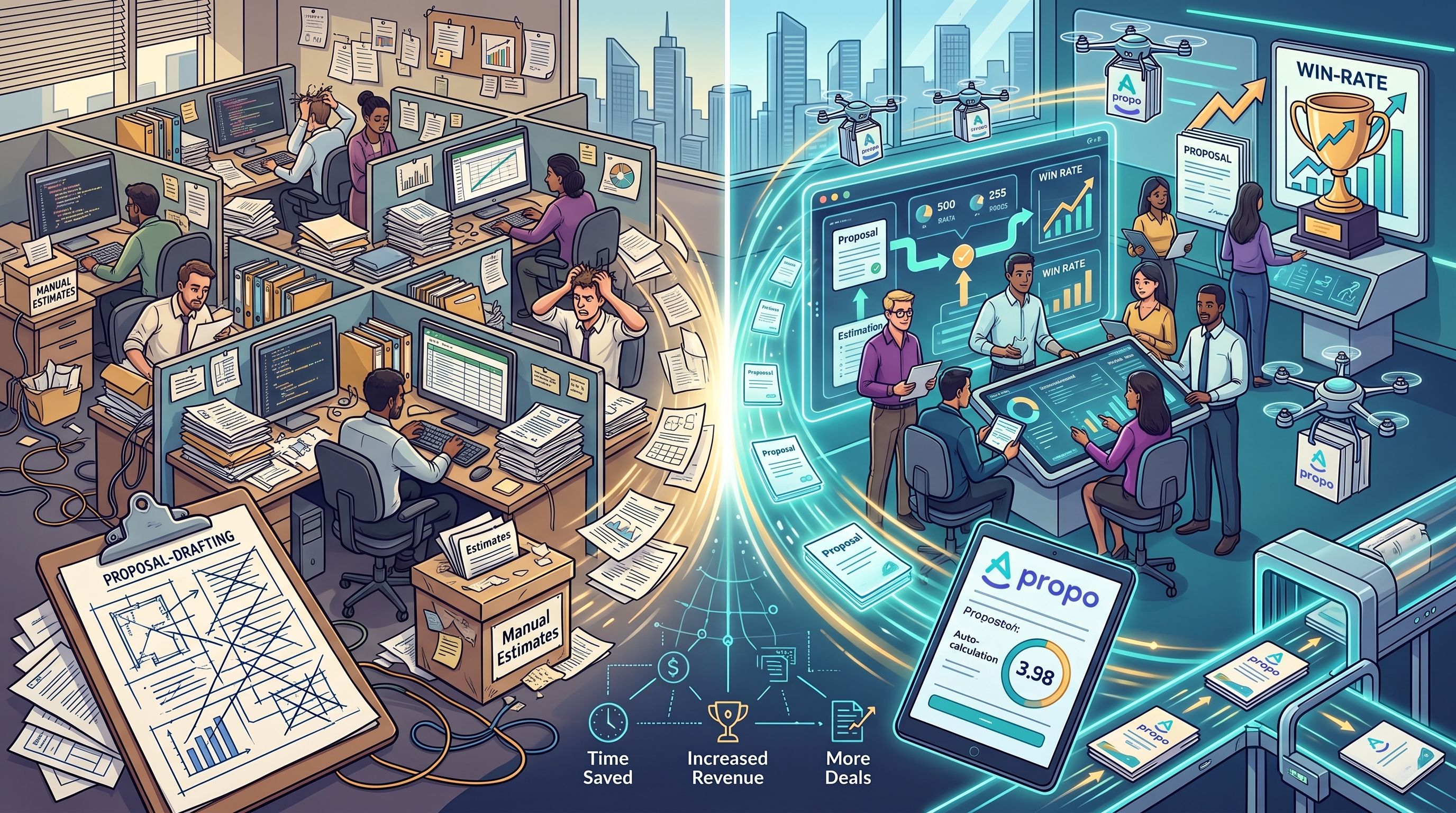
Every agency owner who looks at a proposal automation tool asks the same question: will this pay for itself? Most vendors answer with a vague “agencies save 70% of their proposal time” and a demo. That number is not wrong. It is just useless, because it does not tell you what your agency saves, in hours and in money, against your pipeline.
This article is a framework, not a pitch. You get three formulas: time savings, win rate impact, and pipeline throughput, plus a worked before and after scenario you can re-run with your own numbers in about fifteen minutes.
Why the standard “time saved” pitch understates the ROI
Proposal automation vendors sell on the most visible number: hours spent writing proposals. If your team spends 30 hours per proposal and a tool cuts that to 10, the math looks obvious. But for a software agency, that headline number is the smallest part of the return. Here is why.
Writing the document is the last mile. Before it, someone has to re-read discovery notes, reconstruct scope from memory, re-estimate work that was estimated six months ago on a different project, and manually assemble pricing. The expensive hours in a proposal are not typing hours. They are estimation and coordination hours. A tool that only makes the document prettier saves 20% of the cycle. A tool that makes estimation structured and reusable saves the part that actually scales: the senior time of people who should be delivering, not re-quoting.
That is the core argument of this framework: the largest ROI driver in proposal automation for an IT agency is not document assembly, it is estimation automation. Everything else, faster turnaround, cleaner proposals, better win rate, follows from having an estimate that is fast to produce and defensible when the client asks questions.
Formula 1: time saved on estimation and proposal writing
This is the baseline every other metric multiplies. Measure it before you buy anything.
annual_hours_saved = (hours_per_proposal_before − hours_per_proposal_after) × proposals_per_year
annual_value = annual_hours_saved × blended_hourly_rate
The two inputs that decide everything:
- Proposals per year. Count real proposals, not qualified leads. If your sales team sends 8 proposals a month, that is about 96 a year. Most agencies discover they send more than they think.
- Blended hourly rate. Use the fully loaded cost of the people doing the work, typically the senior estimator, the CTO, or the delivery lead. If the person who writes proposals costs the agency $100/h fully loaded, that is the rate you use, not the junior copywriter’s rate.
A realistic before and after for a mid-size agency:
| Before | After (estimation-first automation) | |
|---|---|---|
| Hours per proposal | 28 | 11 |
| Proposals per year | 96 | 96 |
| Annual hours | 2,688 | 1,056 |
| Hours saved | 1,632 | |
| Blended rate | $90/h | |
| Annual value | $146,880 |
The “after” number is not magic. It assumes the estimate comes from priced components and reusable project data instead of a from-blank-page exercise, and the document is assembled from that structure rather than rewritten by hand. Cut the hours in half and the annual value is still around $73k, which already beats the subscription cost of almost any tool on the market.
Formula 2: win rate impact
Time savings are certain. Win rate is where the upside lives. Automation improves win rate through two mechanisms, and it is worth separating them because they have different paybacks.
Mechanism A: speed. When a proposal goes out in 48 hours instead of 10 days, you stop losing deals to competitors who answered first and to clients whose procurement cycle moved on. Faster proposals also let you cover more opportunities while they are still warm.
Mechanism B: credibility. A proposal built from a structured estimate, with assumptions listed, components priced from your own delivery history, and a defensible range instead of a round number, answers the questions a client committee actually asks. The biggest reason IT proposals lose is information failure: the client cannot see what they are buying or why it costs what it costs. Automation that only generates prettier documents does nothing here. Automation that carries real estimation data does.
The formula:
annual_win_rate_value = proposals_per_year × (win_rate_after − win_rate_before) × average_deal_value × margin_on_dealContinue the scenario. Say the agency wins 24 of 96 proposals (25%), average deal value is $60k, and the margin on delivered work is 30%. A realistic lift from structured, fast proposals is 3 to 5 points. Not a fantasy doubling, a measurable gain.
96 × (0.29 − 0.25) × $60,000 × 0.30 = 96 × 0.04 × $60,000 × 0.30 = $69,120Five extra won deals per year at $60k each, on 30% margin. That is not revenue. That is profit added on top of the time savings. Note the formula uses margin, not deal value: a new deal is only worth what it contributes after delivery costs, and an agency that wins with accurate estimates keeps more of it.
Formula 3: pipeline throughput
The third lever is the one owners feel first but quantify last: capacity. If estimating a project takes two senior people a week, and your pipeline has three hot opportunities at once, something has to give. Proposals get slower, quality drops, or your best engineers get pulled off delivery to save a sale.
Automation changes the constraint. When the per-proposal cost drops from 28 to 11 hours, the same two people can cover about 2.5 times the proposals without hiring. Throughput does not require more win rate to matter. If you already lose deals to your own response time, or if you quietly skip opportunities because you cannot staff the estimate, the capacity is the value.
additional_proposals_capacity = freed_hours_per_month ÷ hours_per_proposal_afterIn the scenario, freeing 136 hours a month (the 1,632 annual hours divided by 12) at 11 hours per proposal means capacity for about 12 additional proposals a month, which you can either use to pursue more business or return to delivery as recovered senior time. The honest answer for most agencies is a mix of both.
The estimation-first caveat
One caveat keeps coming up when agencies do this math honestly: document automation alone does not move formulas 2 and 3. A tool that formats your existing proposal faster saves typing time, but the 28 hours never came from typing. They came from reconstructing scope, re-estimating, and chasing numbers. If you automate assembly but keep estimation manual, you compress 28 hours to maybe 22, and you get none of the win rate or throughput upside.
The tools that change the equation are the ones that automate the estimate itself: component-based pricing, reuse of your own historical project data, market benchmarks, and an estimate that lives in the same structure as the proposal. That is why this article keeps coming back to estimation. Not because estimation tools have better marketing, but because for an IT agency the estimate is where 60 to 70% of proposal hours and most of the client’s trust live. Automation that skips it automates the cheap part.
A sanity check before you buy
Run the three formulas with your real numbers before evaluating any vendor. You need four inputs: proposals per year, hours per proposal, blended rate, and average deal value with margin. If you do not know your own hours per proposal, time-box the next two proposals and log the hours. Two data points are enough to start, and the exercise itself usually produces the first “we spend how much on this?” moment.
Then apply a simple payback rule:
payback_months = annual_tool_cost ÷ (monthly_value_from_formulas_1_2_3)If the tool you are evaluating pays back in under 6 months on time savings alone, which the scenario above suggests most serious tools will, the win rate and throughput upside is free. If it does not survive the time-savings math, no amount of feature envy will fix it, because the other two levers require the estimation automation that produces the time savings in the first place.
Recommendations
- Measure before you buy: log hours per proposal on the next two proposals, count real proposals per year, and set your blended rate.
- Run Formula 1 first. Time savings is the floor of the business case.
- Treat win rate (Formula 2) as the upside, but price it on margin, not deal value, and use a conservative 3 to 5 point lift.
- Ask every vendor one question: does this automate the estimate or just the document? If the answer is the latter, the ROI ceiling is low.
- Re-run the framework quarterly. The number that matters is not the payback at purchase, it is the compounding effect of faster, more credible proposals on a pipeline that keeps growing.
Summary
The ROI of proposal automation software for an IT agency is not a marketing statistic. It is three formulas you can run with your own numbers. Time saved on estimation is the floor: it alone usually pays for the tool. Win rate is the upside, worth more in profit than in revenue. Throughput is the hidden capacity nobody budgets for. And the common thread in all three is that the return comes from automating the estimate, not the document. Run the math on that basis, and the buying decision stops being a leap of faith.
Automate the estimate, not just the document
See what estimation-first proposal automation returns.
Component-based pricing, historical project data, and the estimate living in the same structure as the offer.
See how Apropo protects marginIf you want to see what estimation-first proposal automation looks like, component-based pricing, historical project data, and the estimate living in the same structure as the offer, it is worth testing a CPQ tool built for software agencies.